

The Project
Adolescents and young adults who are currently not in school, not in vocational training, and not working find themselves in a unique situation and deserve special attention.
This group is often referred to as NEET (Not in Education, Employment, or Training). Their life circumstances, past experiences, and future prospects have so far received too little attention in research, practice, and policy.
The ZAP-project is dedicated to the NEET target group. The focus is on the consistent involvement of the participants: We engage them early on and at key points in the research process so that their concerns and perspectives are heard and translated into concrete improvements for services and structures.


Goals
Our goal is to gain a comprehensive understanding of the living conditions of adolescents and young adults who are not currently in school, education, or employment.
To this end, we systematically document educational and training pathways, obstacles in the institutional and social environment, as well as factors that have helped in the past or could provide support in the future.
We want to understand how adolescents and young adults who are not in school, training, or employment experience their daily lives and view their future. We aim to identify what helps and what hinders them, and to track how their situation changes over the course of a year.
From this, we derive concrete recommendations to ensure that support services are better tailored and have a faster impact – with the goal of ensuring that the perspectives of young people are given greater consideration in both practice and policy.

Target Group NEET
ZAP focuses on young people who are not in education, employment, or training (NEET). These individuals often face significant challenges – including, for example, serious mental health impacts.1
Recent developments underscore the urgency of collaboratively addressing the situation of NEETs and exploring potential ways to improve it:

What we do
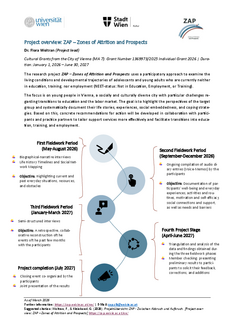
Our study is qualitative. This means we conduct in-depth interviews with the participants and take a close look at their experiences.
It is a longitudinal study design. This means we follow the same young people over an extended period, with several sessions scheduled for 2026 and 2027.
We use various methods:
- Narrative interviews: Participants talk about their lives and their experiences to date in education, training, and work.
- Life history timelines: A line running from left to right. Together with the study participants, we mark important events and influences on it.
- Social network mapping: An overview of important people. It shows who is close, what relationships exist, and how frequent the contact is.
- Voice Memo: Short notes from the young people about their daily lives.
We use these visual methods during the interviews and also between sessions. They help to deepen the narratives. This allows us to better identify which social relationships shape the young people’s lives.
We then summarize all the information and compare it. This is called an integrative analysis. Finally, we prepare the results for various target groups: for practitioners, the general public, and academia. We also share the results with all participants.

References
- Venkatesan, R. G., Karmegam, D., & Mappillairaju, B. (2024). Exploring determinants of school dropout across regions in India: a comprehensive meta-analysis. Journal of Computational Social Science, 7(2), 1665–1697. https://doi.org/10.1007/s42001-024-00285-4
